
The Silk Road, often abbreviated as the Silk Route, primarily refers to the overland trade corridor. Broadly speaking, it consists of two branches: the overland Silk Road and the Maritime Silk Road.

In its narrow definition, the Silk Road was a land route departing from ancient Chinese capitals Chang’an and Luoyang. It ran across Gansu and Xinjiang, stretched into Central and West Asia, and linked up with countries bordering the Mediterranean Sea. The starting city varied in line with dynastic capitals. Chang’an, today’s Xi’an, acted as the origin in the Western Han Dynasty. The starting point moved to Luoyang in the Eastern Han Dynasty, during which the route reached Europe for the first time.
Multiple departure hubs took shape in the Wei, Jin, Southern and Northern Dynasties, such as Luoyang, Chang’an, Pingcheng and Ye. Jiankang also served as a temporary starting port back then. In the Sui and Tang dynasties, trade voyages set off from the West Market, Kaiyuan Gate and the ancient Luoyang City. Kaifeng became the starting capital in the Northern Song Dynasty. The route was originally built mainly for exporting Chinese silk.
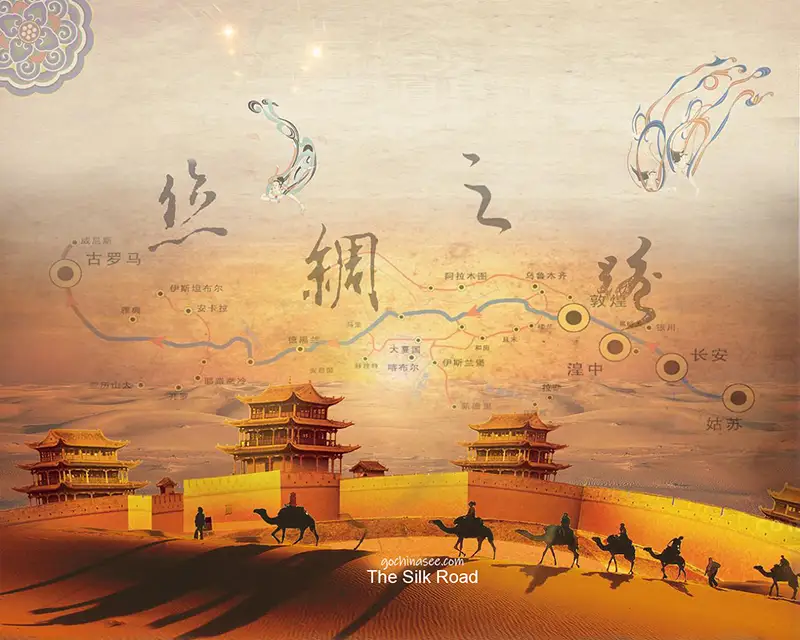
In 1877, German geographer Ferdinand von Richthofen named this passage the “Silk Road” in his book China. The term described the western trade path between China, Central Asia and India from 114 BC to 127 AD, with silk trade as its core business. This title gained quick recognition and official acceptance among scholars and ordinary people.
The Maritime Silk Road facilitated maritime trade and cultural communication between ancient China and foreign lands. Centered on the South China Sea, it is also called the South China Sea Silk Road. First established in the Qin and Han dynasties, it grew prosperously from the Three Kingdoms era to the Sui Dynasty, and peaked across the Tang, Song, Yuan and Ming periods. It is one of the oldest shipping routes ever discovered.
On June 22, 2014, Silk Roads: the Routes Network of Chang’an-Tianshan Corridor, the eastern segment of the overland Silk Road jointly applied for by China, Kazakhstan and Kyrgyzstan, was listed as a World Cultural Heritage site. It became the world’s first successfully registered transnational cooperative World Heritage project.